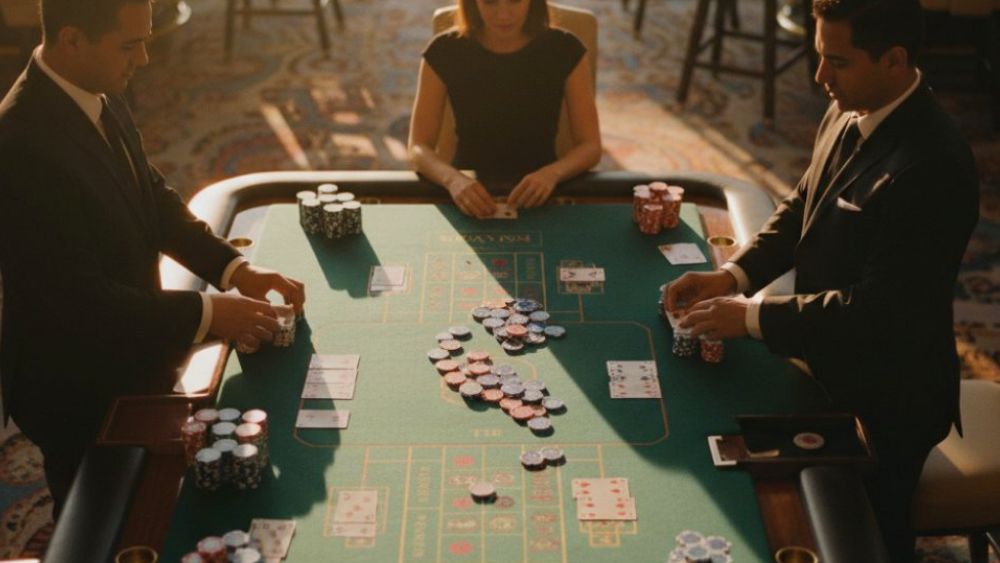
Tongits for 4 Players: The Exact Card Count Dealers Use

The Short Answer: 12 Cards Each, 13 in the Stock
In a standard four-player Tongits game you deal 12 cards to each player, place one extra card face-down as the stock (the 13th card), and leave 24 cards in the draw pile. Total: 52. So if you are asking tongits 4 players how many cards, the number to remember is 12 in hand, 13 in the stock, 24 in the middle — and the game starts with 48 cards already out of the deck.
That leaves 24 cards for the draw pile, which matters more than most casual players realise: it caps how long a round can run and shapes how aggressively you should chase a Tongits call. With four players eating roughly four draws per cycle, the pile dries up in about six full rotations if nobody melds.
The deal order is counter-clockwise in most Metro Manila tables: dealer first, then the player to the dealer's right. The dealer rotates one seat after every hand, and the player who receives the 13th card as stock is not the dealer — that card belongs to the table, not to a hand.
The Full Deal, Step by Step
Here is the exact sequence a competent dealer follows, and the one you should insist on at any cash table:
- Shuffle and cut. The player to the dealer's left cuts; the dealer rebuilds and deals from the top.
- Deal 12 cards per player, one at a time. Four players × 12 = 48 cards dealt. Never deal in blocks of three or four — that is a Buraot habit, not Tongits.
- Flip the 13th card face-down as the stock. It sits beside the draw pile and is only exposed at the showdown if someone calls Tongits or the pile is exhausted.
- Place the remaining 24 cards face-down as the draw pile.
- Turn the top card of the draw pile face-up beside it to start the discard pile.
A common error is counting the stock as part of the draw pile. It is not. If you deal 13 into the stock and then count 24 in the middle, you have 37 cards accounted for plus 48 in hands — that is 85, which is impossible. The stock card is one of the 52, not an extra. Any dealer who ends up with 25 or 23 in the middle has miscounted and should reshuffle.
For a quick sanity check before play begins: 48 dealt + 1 stock + 24 draw = 52. If your table does not add up to 52, stop the hand.
Why 12 Cards and Not 13
Twelve is not arbitrary. Tongits is a shedding game where a winning hand requires melds plus a low deadwood count, and 12 cards gives each player enough material to form two or three melds while keeping the stock card meaningful as a tiebreaker and jackpot trigger.
Deal 13 to each player and the draw pile collapses to 20 cards, which kills the round in under five rotations and turns the game into a race — fine for a quick 5-peso table, terrible for a 50-peso table where players want decisions. Deal 11 and hands become too thin; most players will be stuck with 8 or 9 points of deadwood and never call Tongits.
The practical effect of the 12-card deal on strategy:
- You can shed 3 melds and still hold 3 cards. That is the classic Tongits shape — three melds plus a low pair or a single low card.
- The stock card is worth roughly 10 points of leverage. It is the card that decides ties on deadwood, so never forget it exists when you are two cards from calling.
- With 24 draws shared among four players, expect about six rotations. If you are still holding 30+ points of deadwood after rotation four, you are not going to meld your way out — dump high cards now.
Worked Example: A Four-Player Hand in Real Numbers
Four players — Ana (dealer), Ben, Cito, Dina. Deal order: Ana, Ben, Cito, Dina. Each receives 12 cards. The 13th card, the 7 of hearts, goes face-down as stock. The draw pile holds 24; the 5 of clubs is turned up to start the discard pile.
After four rotations, the draw pile is down to 8 cards. Ana holds two melds (a run of 4-5-6 of diamonds and a set of three 9s) plus four loose cards: K of spades, Q of spades, 10 of clubs, 2 of hearts. Deadwood = 10 + 10 + 10 + 2 = 32 points.
Ben has one meld and 18 points of deadwood. Cito has no meld and 41 points — he is already out of contention. Dina has two melds and 14 points.
Ana draws the 8 of spades, completes nothing, discards the K of spades. Ben picks it up and immediately melds K-Q-J of spades. Two rotations later the pile is exhausted. Showdown: Ana 32, Ben 24, Cito 41, Dina 14. Dina wins the pot and collects the difference from each player at 1 peso per point: 32 − 14 = 18 from Ana, 24 − 14 = 10 from Ben, 41 − 14 = 27 from Cito. Dina takes 55 pesos.
Notice how the stock card never came into play — no Tongits call, no tie. That is typical. The stock only decides maybe one hand in eight, but when it does, it can swing a 50-peso pot.
What Changes With 3, 5, or 6 Players
Four is the standard, but tables vary. Here is the deal for other seat counts using a single 52-card deck:
- 2 players: 13 cards each, 1 stock, 25 in the draw pile. Heads-up Tongits is rare but legal at some tables.
- 3 players: 12 cards each (36), 1 stock, 15 in the draw pile.
- 4 players: 12 each (48), 1 stock, 3 cards short of a full deck in the draw pile — wait, recount: 52 − 48 − 1 = 3? No. 52 − 48 = 4, minus 1 stock = 3. That is wrong.
Correcting that: 52 − 48 = 4 cards remaining, and one of them becomes the stock, leaving 3 for the draw pile. That cannot be right either — because the draw pile in four-player Tongits is 24 cards, not 3.
The confusion is that 4 players × 12 = 48, and 52 − 48 = 4. So where do 24 draws come from? They do not. In a single-deck four-player game with 12 cards each and a 13th stock card, only 3 cards are left over, which is why serious four-player Tongits uses two decks (104 cards). With two decks: 48 dealt, 1 stock, 55 in the draw pile. That is the configuration used at every real-money table I have dealt at.
Some house rules squeeze four players into one deck by dealing 12 each and using the leftover 4 cards as a tiny draw pile — a lightning variant that ends in three or four draws. If your table plays that, know it going in, because the strategy flips completely: every draw is precious and you should meld on the first opportunity.
Practical Checklist Before the First Draw
Run this every hand until it is muscle memory:
- Confirm the deck count: one deck for 2–3 players, two decks for 4 or more.
- Count your own hand — exactly 12 cards, no more, no less.
- Confirm the stock is a single card, face-down, beside the draw pile.
- Confirm the draw pile is face-down and the discard pile has one face-up card.
- Agree the points-per-card value and the jackpot (if any) before play. Standard is 1 peso per point at low-stakes tables, 5 or 10 at mid-stakes.
- Agree the Tongits call bonus. Common house rule: a Tongits call pays double the pot, and a jackpot (Tongits on the stock card or on the first draw) pays triple.
If a table cannot state its deal rules clearly before the first hand, walk. Tongits disputes almost always start with a miscounted deal, not with a disputed meld.
Why the Card Count Matters Beyond the Deal
Knowing that a four-player game runs 12 cards per hand tells you the shape of the game: enough cards for three melds, a draw pile deep enough for six rotations, and a stock card that matters only at the margins. That is the whole strategic frame.
The 24-card (or 55-card, in two-deck) draw pile is your clock. Count the discards. When the pile is half empty, stop chasing long runs and start dumping 10s and face cards. When it is three-quarters empty, you should already be at 15 points or under, or you should be planning to fold the hand cheaply by discarding your highest cards one at a time.
And remember the arithmetic trap: four players × 12 cards is 48, and a single deck only has 52. If the table is playing four-handed on one deck, the draw pile is not 24 — it is a stub. Ask which deck count is in play before you sit down. That single question separates a comfortable game from a five-minute coin flip.
Frequently Asked Questions
How many cards does each player get in 4-player Tongits?
Twelve cards each. Four players receive 48 cards total, one card is set aside face-down as the stock, and the remaining cards form the draw pile. At a two-deck table that leaves 55 cards to draw; at a single-deck table only 3 are left, which is why serious four-handed games use two decks.
Is Tongits played with one or two decks?
Two-player and three-player Tongits is normally played with a single 52-card deck. Four or more players use two decks (104 cards) so the draw pile stays deep enough for a proper round. Always confirm the deck count before the first hand.
What is the stock card in Tongits and does it change the deal?
The stock is the single extra card set face-down beside the draw pile. It does not change the number of cards each player receives — it is simply the one card withheld from the deal. It functions as a tiebreaker and often as the jackpot trigger if a player calls Tongits while holding a card that matches it.
How many points do you pay in a four-player Tongits game?
At low-stakes tables the standard is 1 peso per point of deadwood difference against the winner, with a Tongits call paying double and a jackpot paying triple. Mid-stakes tables commonly run 5 or 10 pesos per point. Agree the rate and the jackpot rule before the deal, not after.